AI BL Drama Explained: Where to Watch and How to Make One
AI BL drama is spreading fast on YouTube Shorts and TikTok. Here are the works and channels you can watch now, the tools and video models one episode takes, and the AI disclosure rules.
"They made this without actors?"
Open the comments after watching a BL drama through to the end on YouTube Shorts and that sentence is almost always there. The two leads on screen are not real actors but AI generated characters, and the palace corridor or school rooftop behind them is not a filmed location.
Next to conventional web drama the difference is clear. Casting and shooting schedules are gone, and prompts and generation time took their place, so small channels now keep serials running. One channel that opened four months ago has passed about 7.5 million cumulative views.
This article covers what AI BL drama is, which works and channels you can watch now, what it takes to make one episode yourself, and the parts that cause trouble when you miss them, such as AI disclosure duties.
What AI BL drama is
AI BL drama is short-form drama that renders a BL (Boys Love) story with AI generated video. An episode usually runs one to three minutes, and it goes up on YouTube Shorts, TikTok, and Instagram Reels in a vertical 9:16 frame.
The biggest difference from live action drama is the characters. Instead of casting actors, creators build the leads' faces with an AI image model first, then feed those images into a video model as references so the same face appears in every scene. The cost of changing costumes or period settings drops to almost nothing.
Works you can watch now
Not many works have reached scale yet. As of September 15, 2026, two Korean AI BL drama serials stand out, and both are based on YouTube channels.
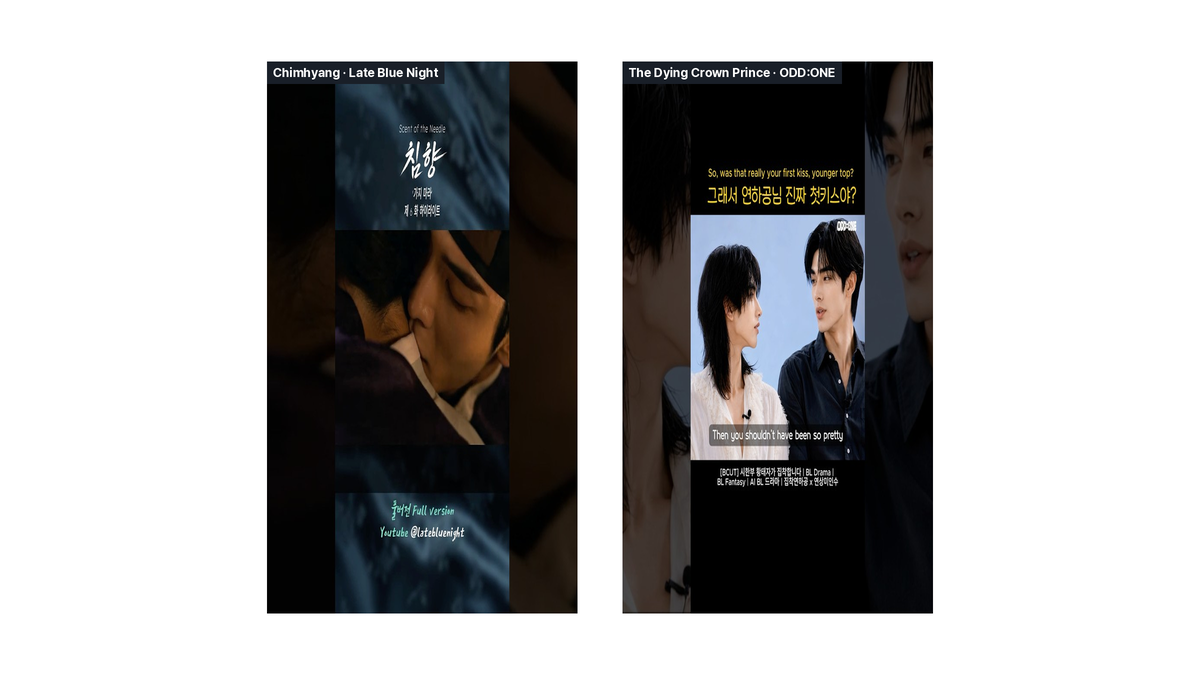
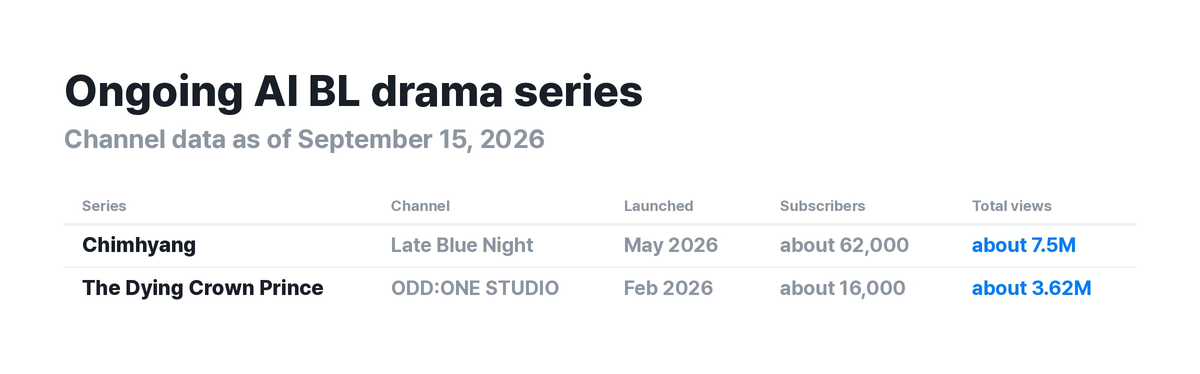
Chimhyang is a period BL set in the Joseon dynasty. Channel information says it opened in May 2026, and as of September 15 it has about 62,000 subscribers, roughly 7.5 million cumulative views, and 32 uploaded videos. Reaching those numbers four months after launch shows how fast this genre grows. One highlight Shorts recorded about 1.12 million views, and the work runs on the Late Blue Night channel.
The Dying Crown Prince Is Obsessed is a contemporary BL. The ODD:ONE STUDIO channel describes itself as an AI BL drama and boy group production house. It opened in February 2026 and has since built up about 16,000 subscribers, roughly 3.62 million cumulative views, and 66 videos. It holds a fixed schedule, releasing a new episode every Thursday at 9 p.m.
What the two channels share matters more. Their top viewed uploads are not full episodes but highlights and teasers cut from single scenes. They build the long episode first, then push the scenes likely to land hardest as Shorts to draw traffic. Titles carry AI BL Drama or the work name verbatim, used as a signal for both search and recommendation.
Filling the space between episodes with spin-off content is also shared. Late Blue Night posts OST collections, deleted cuts, character commentary, and a contemporary side story as separate slots. ODD:ONE STUDIO has released several original OSTs and runs an AI boy group as a separate IP. One main episode takes a long time, so the formats in between become the real axis of keeping a channel alive.
For reference, Late Blue Night announced global OTT distribution and an offline pop-up store on its channel, and set season 1 of the main series to private for now. An AI drama that started on Shorts moved into distribution and merchandise.
Where to watch
Discovery and full viewing happen in different places.
Discovery happens on Shorts. Clips of about a minute on YouTube Shorts, TikTok, and Instagram Reels are the entrance in practice. Most viewers catch one in a recommendation feed and then go to the channel.
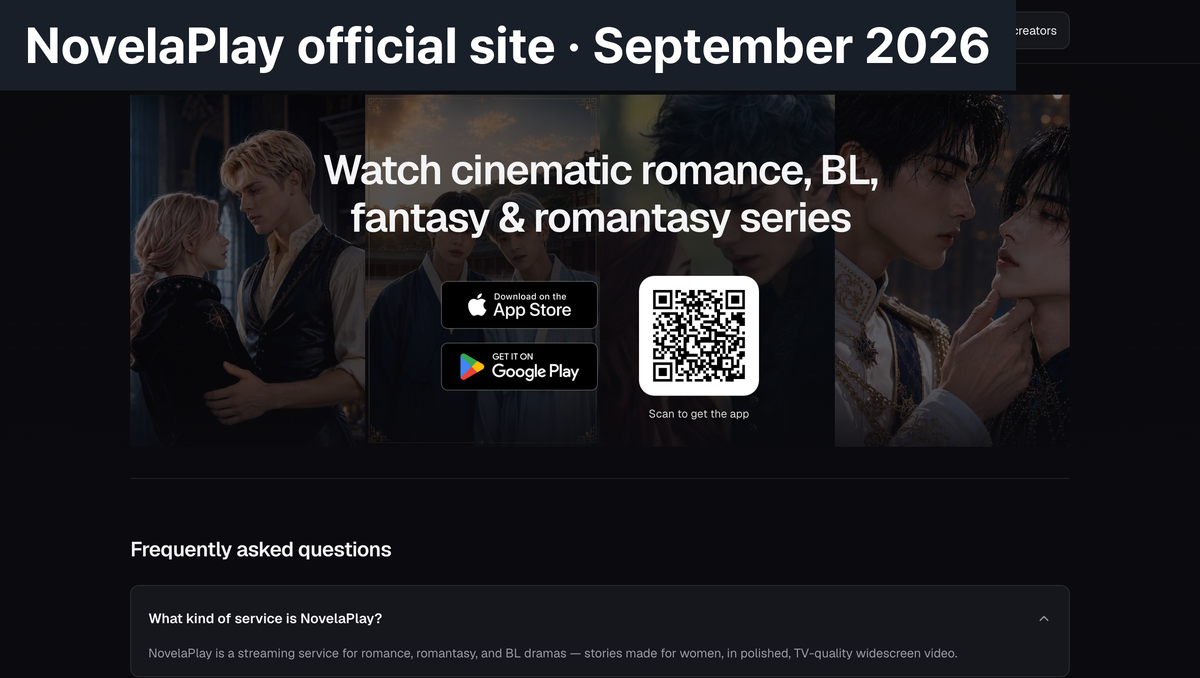
Full viewing happens in dedicated apps or long-form. NovelaPlay is a streaming app for women-oriented AI drama covering romance, romance fantasy, and BL. Its official introduction presents horizontal, film-like viewing rather than one-minute short-form as the difference. Most works start with free episodes, and later ones open through purchase or daily rewards. The official FAQ lists more than twenty subtitle languages, including Korean, English, and Japanese.
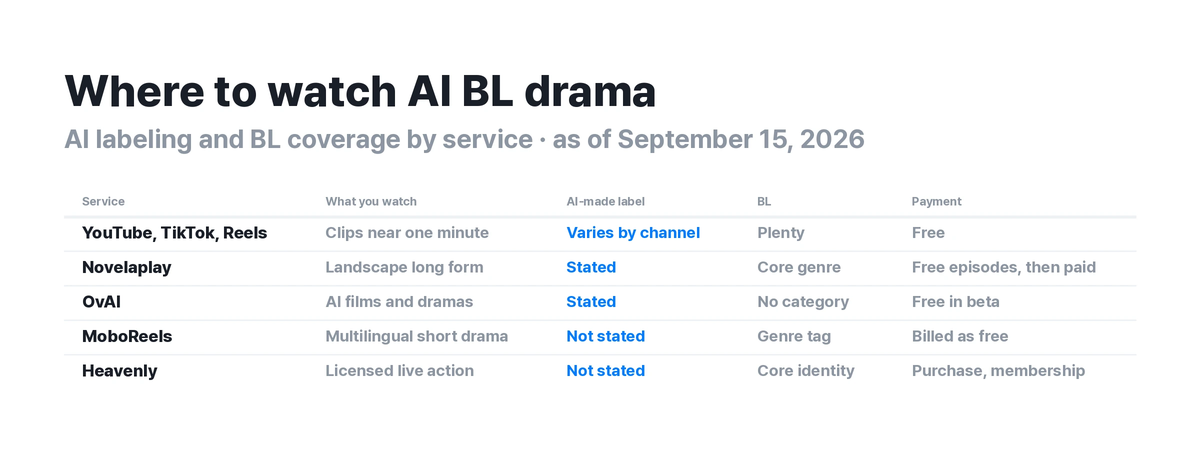
It helps to separate services that are easy to confuse. OvAI is a web streaming service collecting AI made films and dramas, free during its beta, but its genre list has no BL category. Heavenly is the reverse: a platform built around BL, though it licenses live action BL dramas from Korea, Thailand, Japan, and Taiwan. Nothing in its service description states AI production.
Among the four services the Carat editors checked, NovelaPlay was the only Korean service listing AI production and BL together as categories. MoboReels, a multilingual short drama app, also has a BL tag and Korean pages, but the site states no AI production.
The two surfaces are already connected. ODD:ONE STUDIO announced on its channel that the full version of season 2 premieres on NovelaPlay first. The path from Shorts viewers to the full version in an app is already running.
Why BL broke out first
AI video is not genre specific, so the fact that every channel at scale the Carat editors checked is BL makes a good starting point. The reason sits in constraint structure rather than taste.
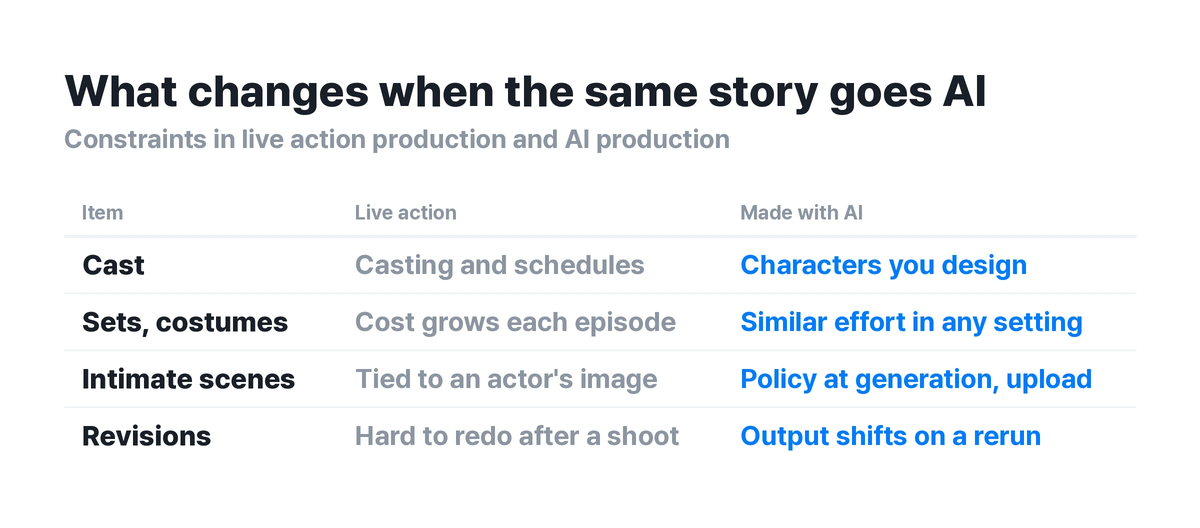
First, casting constraints disappear. Live action BL drama carries agency negotiation and image management as variables from the casting stage. An AI made character involves none of that negotiation, and the creator can design the look and mood from the start.
Second, the more expensive the setting, the bigger the gain. Popular BL settings run to palaces, chaebol houses, and omegaverse, all heavy on sets and costumes. In live action the art budget rises with every episode, but in generated video a palace corridor and a modern office take similar effort.
Third, adaptation lagged behind the source material. BL is an established category in Korean web novels and webtoons, but screen adaptations never piled up the way romance or action did. Demand outran supply for a long time, and individual creators started filling that gap first.
Fourth, the fandom is used to derivative work. BL readers have a long history of fan fiction and fan art, so they feel less distance from original stories with no source work. That looks like the reason new channels get fast early reactions on original uploads.
AI production also costs something. Viewers who liked the acting and timing of live action performers see a missing layer in fine facial expression, and parts of source fandoms object to unauthorized adaptation. Neither of these resolves on its own as models improve.
What one episode takes
Finishing one episode breaks into five steps. The order is similar whatever tools you use, and each step fails in a different way.
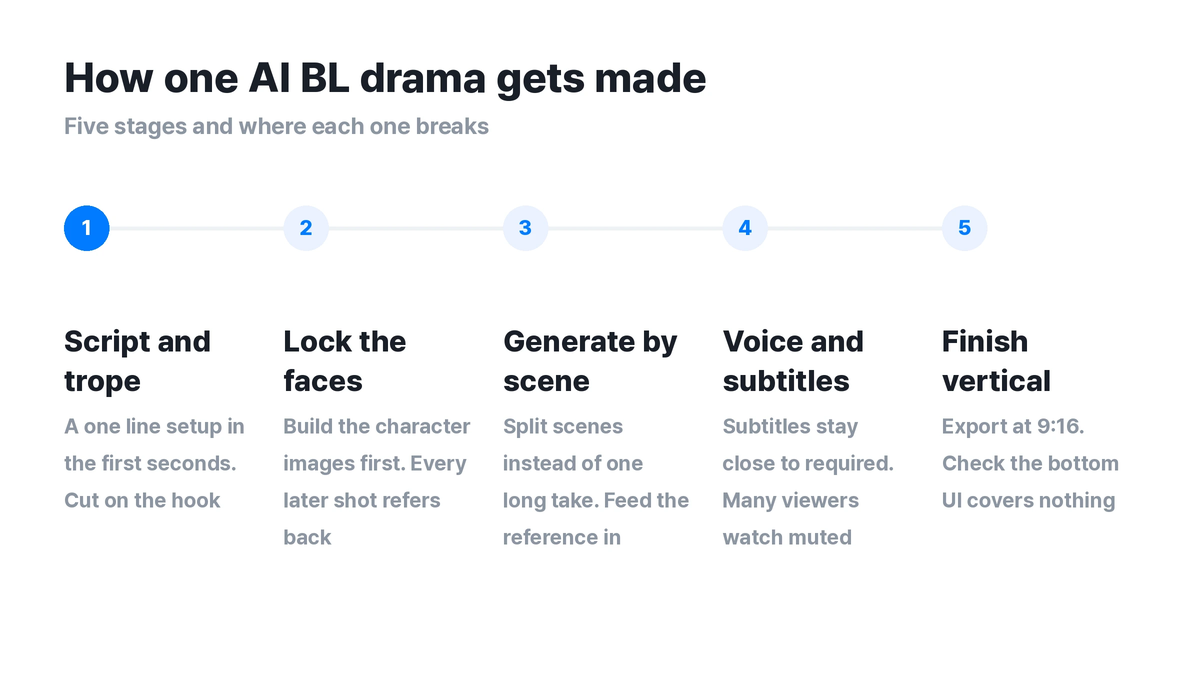
1. Set the script and the trope. Short-form has to reveal the relationship within the first few seconds. Tropes that explain themselves in one line, such as status gap, unrequited love, or reunion, work because there is no time to explain. If you plan to serialize, end the first episode at the point that carries into the next.
2. Lock the leads' faces. Build the character images with an image model first, and keep several cuts at different angles, such as front and profile. These images become the reference for every later scene, so a half done job here makes the face drift across the whole serial.
3. Generate video scene by scene. Split the scenes instead of pulling one long video at once. Feed the character images you made earlier into each scene as a reference, and specify camera movement and emotion in sentences.
4. Add voice and subtitles. Adding audio separately used to be the default, but several models now generate the dialogue too. Either way, Korean subtitles are close to mandatory. You need them to keep viewers who watch with the sound off.
5. Finish in a vertical frame. Join the cuts, add background music and a title, and export at 9:16. Safe areas differ by platform, so check that subtitles do not sit under the bottom UI.
What you decide at each step is similar regardless of genre. The flow from planning to render is set out in more detail in the AI short-form drama production guide.
Which video models people use
The line about adding dialogue separately no longer holds as of September 2026. The major video models all state native audio generation in their official documentation, and that includes character dialogue.
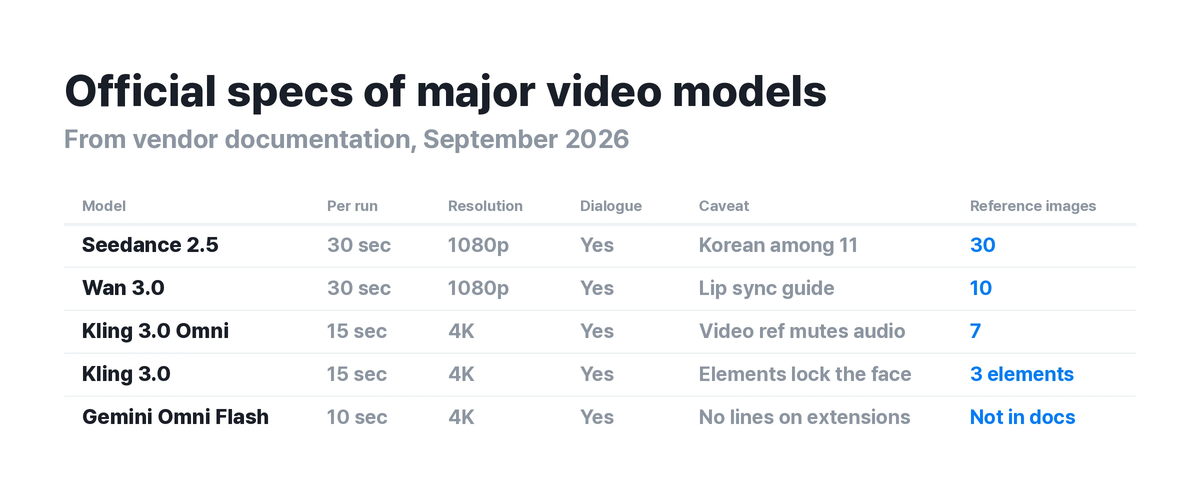
Length and resolution do not go together right now. Seedance 2.5 and Wan 3.0 generate up to 30 seconds at once but cap at 1080p, while Kling 3.0 and Gemini Omni Flash support 4K with single-run lengths of 15 seconds and 10 seconds. Gemini Omni Flash extends to 40 seconds in total, though its official documentation states that dialogue cannot be added when extending an uploaded video.
For serials, reference capacity is where models actually split. The same character has to appear every episode, so how many reference images you can feed carries straight into face consistency. Per official documentation, Seedance 2.5 takes up to 30 reference images, Wan 3.0 takes 10, and Kling 3.0 Omni takes up to 7 depending on conditions. Kling 3.0 standard locks characters with 3 elements instead of reference images, so the endpoint you pick becomes the constraint.
How explicitly Korean dialogue is stated differs by model. Seedance 2.5 lists voiced video generation in 11 languages including Korean in its official capability table. Wan 3.0 states native output of dialogue, ambient sound, and effects, and ships a lip sync prompt guide. Gemini Omni Flash documentation states that only English was formally evaluated, so check results first before trusting it with Korean dialogue.
What each model gives up is clear too. Seedance 2.5 is strong on reference capacity and length, but the higher version number does not bring 4K. Its official capability table caps at 1080p, so a high resolution master needs another choice. Kling 3.0 Omni supports 4K and multi-shot, but a reference video forces audio off, and Gemini Omni Flash puts a watermark on every output.
If you build a short-form episode scene by scene, character locking and Korean dialogue bite before length does. When the spec tables alone make the choice hard, you can run the same prompt across a list that puts several video models on one screen and compare results side by side.
Where people actually get stuck
People who have made one run into the same walls. Most of them sit in consistency and policy rather than model performance.
The face changes between episodes. Even with reference images, a large angle change or different lighting shifts the character subtly. Reusing the same character images and avoiding extreme angle directions is safer.
Korean dialogue depends on the model. Some models name Korean as an officially supported language, while others document that only English was formally evaluated. Long Korean dialogue on the latter can leave mouth and sound out of sync, so many creators write short lines or avoid holding a speaking face front on for long.
Rating calls differ by platform. Physical contact scenes common in BL stories sometimes get refused at generation, and sometimes get age restricted after upload. The same video can be judged differently by platform, so putting your whole distribution on one surface hurts more.
The next episode does not arrive. The most common request in comments is the next episode, but when one episode takes long, the serial breaks. More channels now fill the gap with short side stories or epilogues using the same characters instead of building a new main episode.
AI disclosure duties and copyright
What you have to follow when publishing is the law and platform policy. The two rules point at different parties.
On the legal side, look at who carries the duty first. The framework act on the development of artificial intelligence and the establishment of a foundation for trust, shortened to the AI Framework Act, took effect on January 22, 2026. Per the text on the national law information center, Article 31 paragraph 2 requires generative AI output to be marked as AI generated, and the duty falls on AI business operators, not on viewers or general users.
The notice duty in paragraph 3, covering video hard to tell from reality, points at the same party. The scope of operators does include those providing products or services using AI, so a channel that earns revenue should check its own situation separately.
Platform policy asks the creator. Separate from the law, video platforms require the person uploading to state AI generation directly. Missing the disclosure setting can get a video taken down or its reach cut, so make a habit of checking that field on the upload screen.
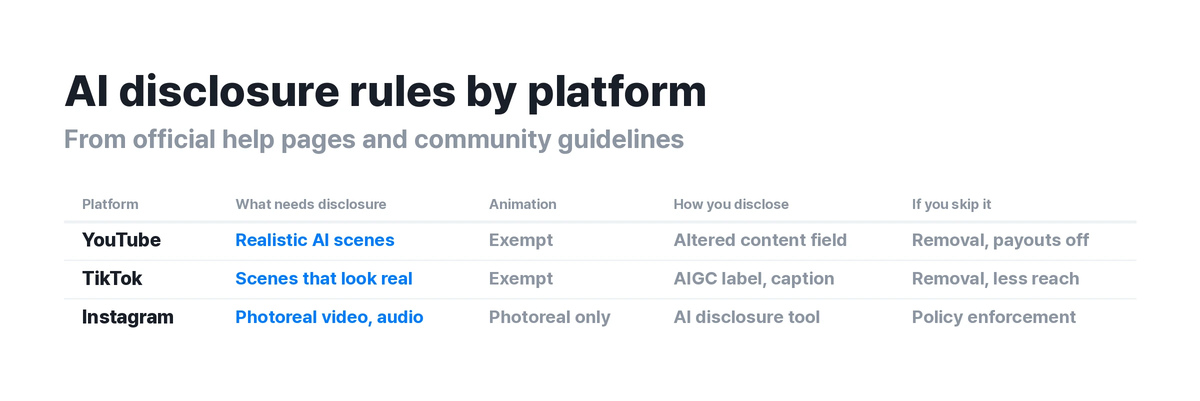
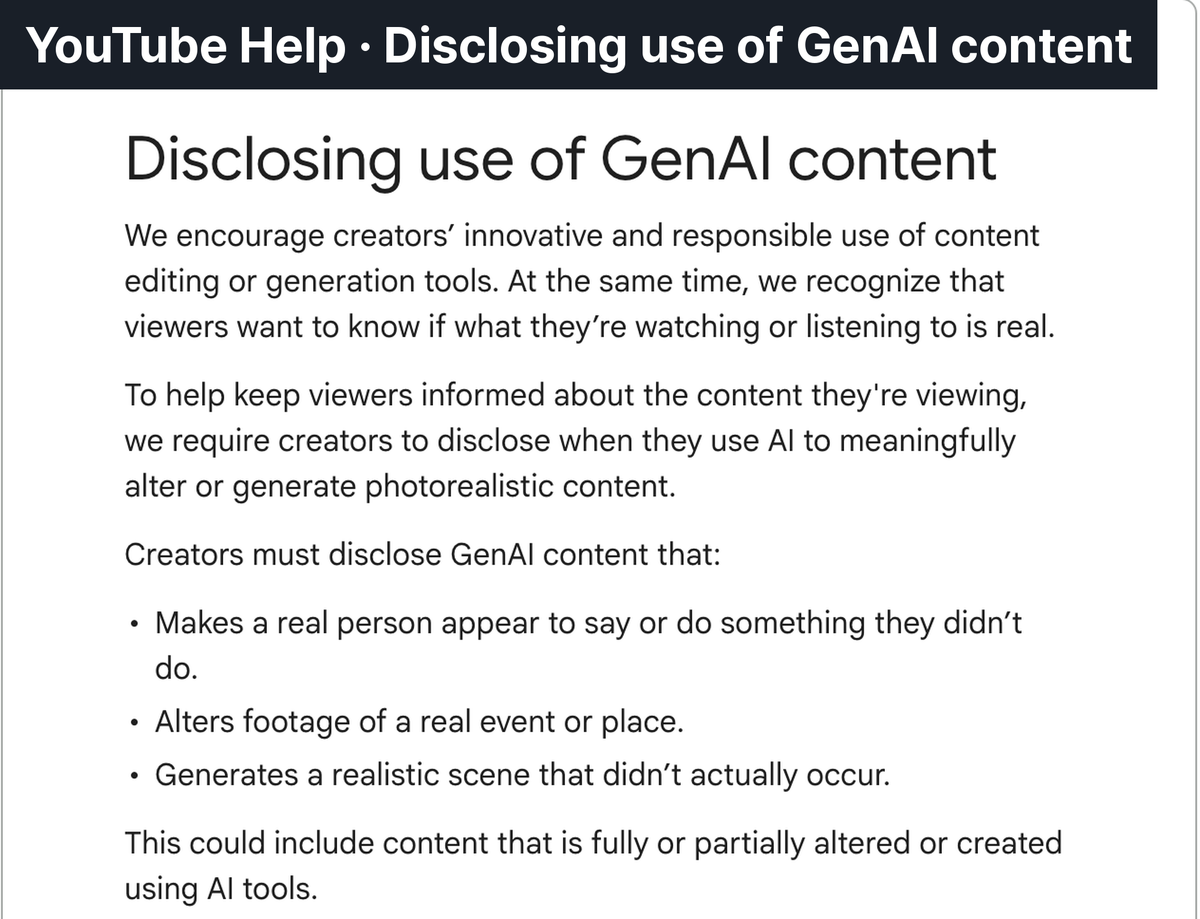
The baseline is not whether AI was used but whether it looks real. YouTube treats realistic content showing things that did not happen as disclosable, and says fully animated video or unrealistic styling does not need disclosure. TikTok also exempts animation style art. Realistic AI BL drama counts as disclosable on all three platforms.
Disclosure costs you nothing. YouTube official help states that disclosing AI content does not limit your audience or affect monetization eligibility. Refusing to disclose repeatedly can get a label applied by force or the content removed, and can suspend partner program participation.
Labels applied automatically cannot be removed. All three platforms are moving toward reading content credential metadata such as C2PA and applying labels automatically. YouTube states flatly that creators cannot adjust a label applied that way. More generation tools now embed that metadata, so turning disclosure on from the start is simpler than treating it as optional.
Real people's faces are a different matter. TikTok bans AI content using the likeness of private individuals and anyone under 18 without consent, regardless of labels. That is why building lead faces to resemble real actors or idols is risky.
Stories with a source work are a separate matter. Carrying over the settings and characters of a web novel or webtoon you like creates copyright problems. Making faces resemble real people is risky on publicity rights. Original characters and original stories are safer, and they leave the channel with an asset.
Frequently asked questions
Where can you watch AI BL drama
YouTube Shorts, TikTok, and Instagram Reels are the easiest places to find it. The main serials Chimhyang and The Dying Crown Prince Is Obsessed run on the Late Blue Night and ODD:ONE STUDIO channels. Watching long episodes in sequence means moving to a dedicated app or a long-form surface. NovelaPlay works that way. Searching AI made BL together with live action BL mixes the results, so check whether the service states AI production itself.
Can one person make an episode alone
Yes. Script, character images, scene video, voice and subtitles, and vertical finishing all run in one person's hands. Still, the channels at scale today also run OSTs and side stories separately. Continuing a serial is much harder than the first episode, and the work that takes the most time is keeping the face identical across episodes. Switching between several models in one place cuts the effort of moving tools at every step.
Do you have to state that a video was made with AI
When uploading to a platform, yes. The disclosure duty in Article 31 of the AI Framework Act points at AI business operators, but platforms such as YouTube and TikTok make the uploading creator choose AI generation directly. For video with characters who look like real people, skipping the disclosure is the riskiest choice.
Can you adapt a web novel you like with AI
Not without permission from the author or the rights holder. Carrying over settings, characters, and lines as they are can infringe copyright, and the wider the reach of short-form, the faster the problem surfaces. Even posted as fan work, it can draw a platform report or a takedown request. Original characters and original stories carry none of this risk, and leave far more freedom for later distribution or licensing.
How do you add Korean dialogue
More models now build the dialogue for you. Seedance 2.5 documents voiced video generation in 11 languages including Korean, and Wan 3.0 states native output of dialogue, ambient sound, and effects. How explicitly each model states Korean differs, so check results with a short line before handing over long dialogue. Adding subtitles separately is still the default.