Restroom Etiquette Poster
Design a practical restroom etiquette poster with AI prompts and responsible review steps.
2026.07.16
「Restroom Etiquette Poster」を思いどおりに作りましょう自分だけの「Restroom Etiquette Poster」を作る
ふだんの言葉で伝えるだけで、Caratが最適な画像や動画を生成します。

毎日100クレジット無料で今すぐ始められます
Restroom Etiquette Poster
Restroom Etiquette Poster Definition and scope
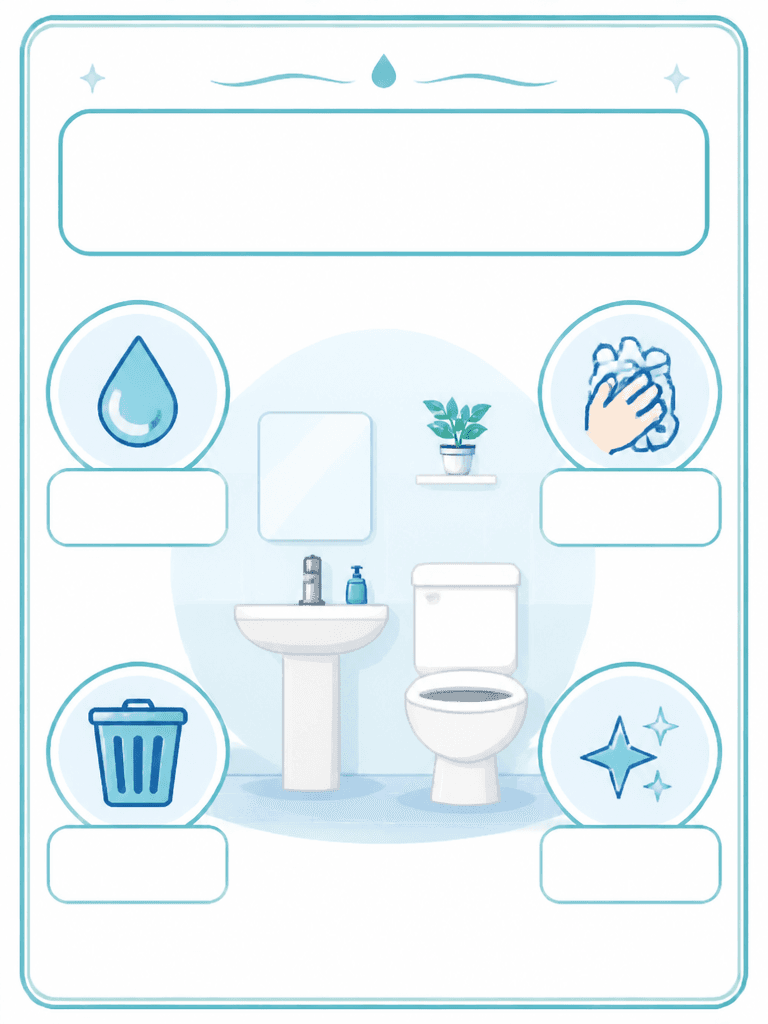
Restroom Etiquette Poster AI prompts turn an educational or public communication goal into a reproducible poster brief. Define the audience, placement, visual hierarchy, key objects, editable copy zones, palette, and intended action. Generated artwork is a draft that still requires factual, rights, accessibility, and production review.
Where to use it
Use it in shared restrooms at schools, offices, shops, hospitals, and public facilities to communicate water saving, hand washing, bin use, and consideration for the next visitor. Adjust icon priority to the audience, placement, and cleaning policy. Test the final layout at both thumbnail and print size, checking contrast, safe margins, factual copy, permissions, and visible generation artifacts.
Why the format works
A sink and toilet pictogram establishes context immediately, while four separate circular icons make actions easier to scan than a dense rules notice. Teal and blue support a clean tone, and generous whitespace protects the readability of edited instructions. Test the final layout at both thumbnail and print size, checking contrast, safe margins, factual copy, permissions, and visible generation artifacts.
Prompt and review checklist
Specify ratio, pictogram set, number of actions, palette, line weight, and blank copy zones. Avoid exaggerated contamination imagery. A facility owner should verify local rules, translations, accessibility contrast, and icon meaning, then inspect pipes, hands, and bin geometry for artifacts. Test the final layout at both thumbnail and print size, checking contrast, safe margins, factual copy, permissions, and visible generation artifacts.
Related prompts
よくあるご質問
Prioritize the intended action and audience, then add verified operational details during editing.
Keep symbols immediately recognizable while preserving factual accuracy and respectful context.
Limit secondary blocks to what remains readable at small size and link to extended guidance separately.
Add names, schedules, contacts, records, and translations only after a responsible owner checks them.
Clear action and verified context are more useful and trustworthy than exaggerated emotion.
Separate primary and supporting roles, then test contrast, color vision accessibility, and grayscale output.
Check reduced-size readability, facts, rights, safe margins, and object artifacts before publication.