Tracing Art Style Illustration
Prompts for illustrations that show reference imagery, tracing paper, construction lines, and layered drawing stages.
2026.08.28
把「Tracing Art Style Illustration」做成你想要的样子做一个你自己的「Tracing Art Style Illustration」
用大白话说出来就行——Carat 会为你生成合适的图片和视频。

每天 100 免费积分,现在就开始
Tracing Art Style Illustration
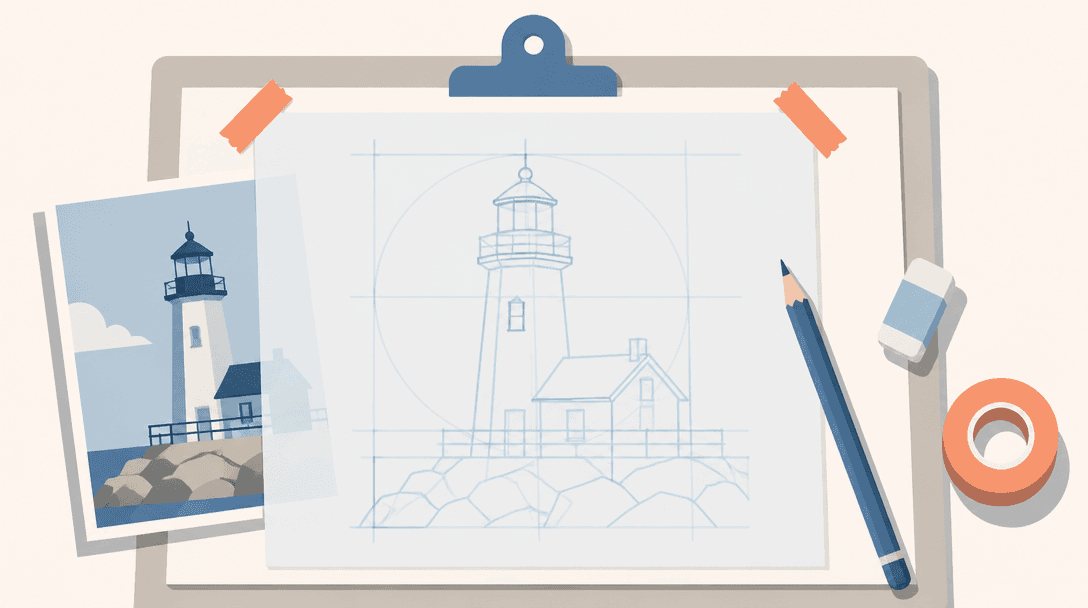
Tracing art style illustration prompts should explain the visible relationship between a reference image and the transparent layer placed over it. Instead of using only the word line art, describe the reference sheet, tracing paper, grid, registration points, construction circles, and final contour lines. Separate the guide lines by color or opacity so the viewer can understand which marks are exploratory and which define the finished drawing. A pencil, ruler, eraser, clip, or masking tape can establish a believable artist workspace, but too many props will compete with the central process. A top-down flat lay makes the layers easy to read, while a three-quarter desk view shows paper thickness and overlap. Use a limited palette of warm ivory paper, pale blue guides, graphite gray shadows, and one restrained accent so the concept stays legible at thumbnail size. The same structure can support educational diagrams, sketchbook scenes, portfolio covers, and process illustrations. Describe the subject's geometry and line behavior rather than naming a specific living artist or copyrighted character. A useful prompt can place a finished reference beside a partially traced version, or show both on the same sheet with clear transparency. Specify line weight, opacity, and the number of visible construction marks when precision matters. For a series, keep the paper tone and light direction consistent while changing the object being traced, which creates continuity without copying a particular artwork.
常见问题
A reference image, transparent overlay, construction marks, registration points, and multiple drawing stages make the process recognizable.
Warm ivory paper with pale blue guides and graphite-gray shadows keeps the layers clear.
No. A few meaningful tools such as a pencil, ruler, and eraser provide context without clutter.
A top-down flat lay clarifies layers, while a three-quarter view reveals paper overlap and depth.
Yes. Separating guide lines from final contours makes the image useful for drawing and design process explanations.
Prompt access follows the service policy, while actual generation may use credits from the selected model.
Limit guide-line colors, line weights, and registration points, and request a minimal set of workspace props.