How to Make Games with AI: Tools, Blender and Assets
To make a game with AI, start by writing down your idea. In Carat Game Studio, you can build games through conversation, create the assets you need, and share the result with a link.
To make a game with AI, start by writing down your idea. In Carat Game Studio, you can build games through conversation, create the assets you need, and share the result with a link.
Browser game examples published in September 2026 are also useful references. A game made with GPT 6 Astra recorded 3.42 million views and 6,776 likes on X. Its creator tried another model before switching to Astra and finishing the prototype. The characters and backgrounds came from separate tools. This article also examines that approach of producing code and assets separately.
First, this article introduces Carat Game Studio’s home screen and workflow. It then compares ChatGPT Sites, Claude Artifacts, and Gemini Canvas, and explains where existing public examples sourced their assets. The tool comparison and development examples are based on research from September 2026. The Game Studio introduction was supplemented using the interface and launch announcement from October 27.
Make Games with AI in Carat Game Studio
Carat Game Studio lets you describe the game you want in words. You can start by selecting a genre or combining styles and settings. The current screen offers match-3, merge, puzzle, runner, shooting, racing, RPG, and tower defense. The exploration section below also lets you browse games published by other people.
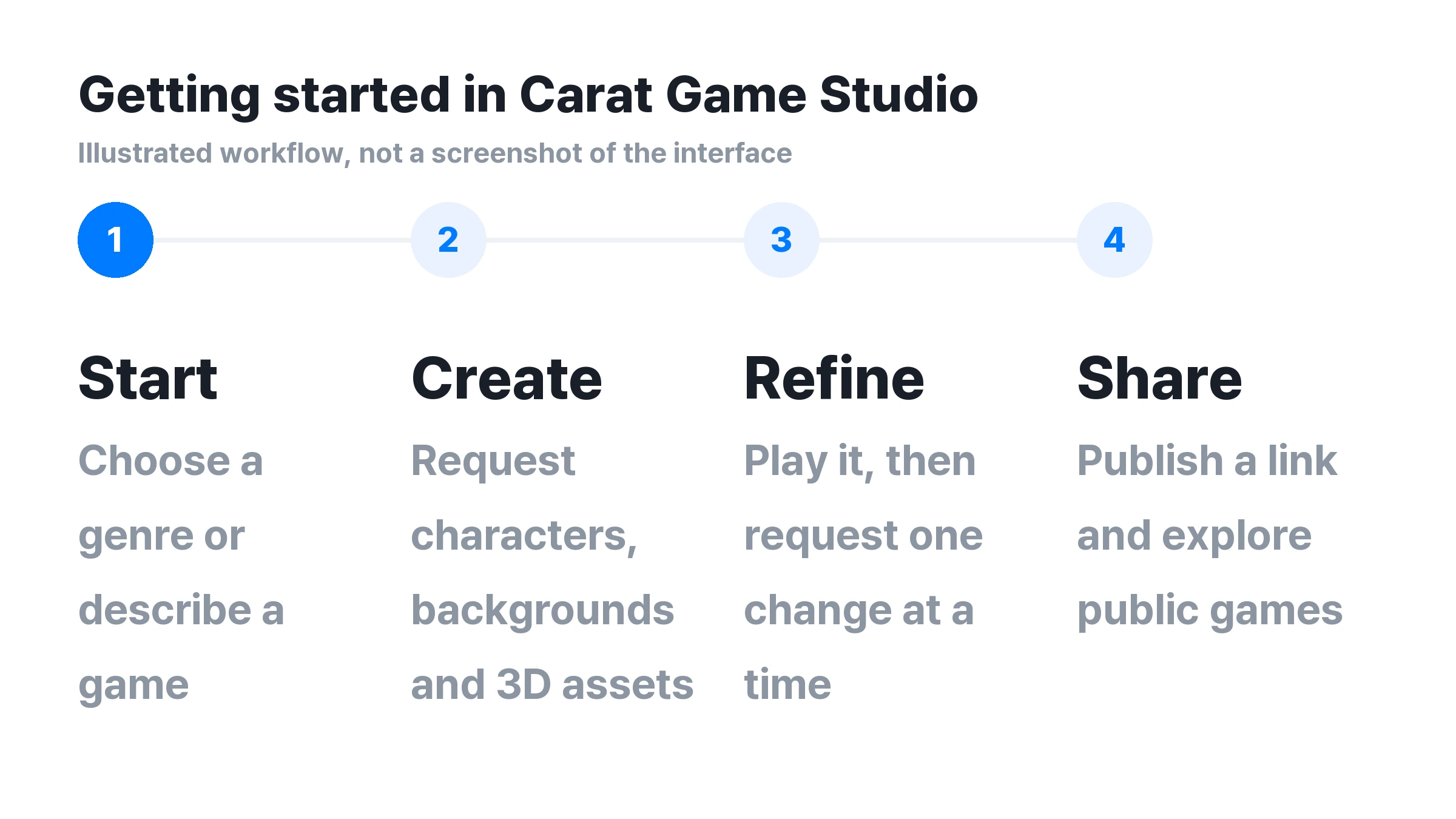
You can also request the characters, backgrounds, and 3D assets your game needs through conversation. If you need assets, check the “Generate assets” option in the input field. You can add your own images or photos of people whose likeness you have permission to use as references. You can share and publish the finished game with a link. On Carat, you can also continue by creating promotional images and videos. Here is an example prompt you can adapt to get started. Play the result, then change one thing at a time, such as “Lower the jump height.”
Create a 2D runner game where a cat jumps between rooftops and collects fish. Make it jump when the player presses the space bar or touches the screen, and restart the game when it hits an obstacle. Create the character and background to match the game’s style.
How ChatGPT Sites, Claude, and Gemini Differ
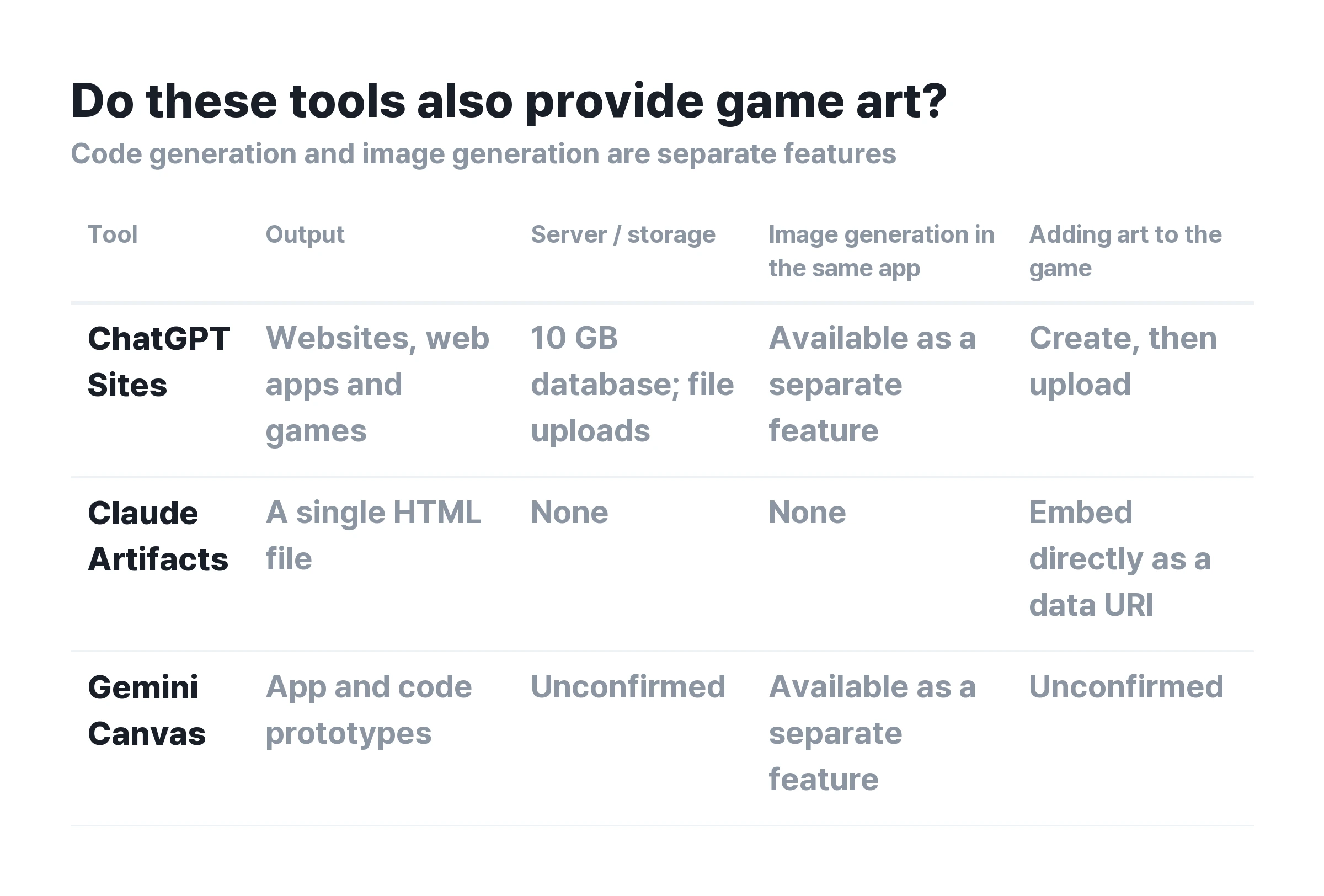
Many articles about making games with AI simply list tools by name. What matters more is what you get as the finished output. Here is how the three compare on that basis.
ChatGPT Sites Includes Hosting
You can use a relational database of up to 10 gigabytes and upload images, documents, audio, and video to object storage. The documentation says the latter has no fixed limit. That difference matters for games that save scores or play history. WebSocket support also allows games that need real-time communication. However, this is a public beta for paid plans, unavailable on Free and Go. Access opened first for Pro and Enterprise, followed by Plus and Business.
The documentation only says usage falls within each plan’s limits; it does not publish specific figures. Communication is also limited to web standards, so you cannot open raw sockets directly. There are restrictions on what you can build: health information services and services for children under 13 are prohibited. You cannot handle payment card details directly either. Using an external payment provider is the only exception.
Claude Artifacts Produces a Single HTML File
There is no backend, and you cannot build a site with multiple routes. That means you cannot accumulate data on a server or show a different screen for each user. In return, anyone with the public link can open it and interact without signing up. This is a quick option if you are building alone and just want to send friends a link. However, games are absent from the official list of outputs. You are building them as interactive components.
Gemini Canvas Links Do Not Open Outside Gemini
The official help documentation says shared links only open within the Gemini domain. That makes it less suitable for distributing what you build outside the platform. On the other hand, it offers the broadest range of the three for working with documents, slides, and infographics on one screen. Games appear in the product overview but not in the help documentation’s output list. The scope of official support varies across documents.
Choosing an AI Game Builder by What You Want to Make
-
Claude Artifacts is quick for a prototype you will test on your own. A single HTML file imposes significant limits but also requires less work.
-
ChatGPT Sites fits a finished game you want to share by link for multiple people to play. Hosting and storage are included.
-
A full 3D project does not end with one tool. You need a setup where an agent controls creation tools such as Blender. This article does not cover moving to game engines such as Unity or Roblox. Its scope ends at outputs that open directly in a browser.
Where AI Game Characters and Backgrounds Come From
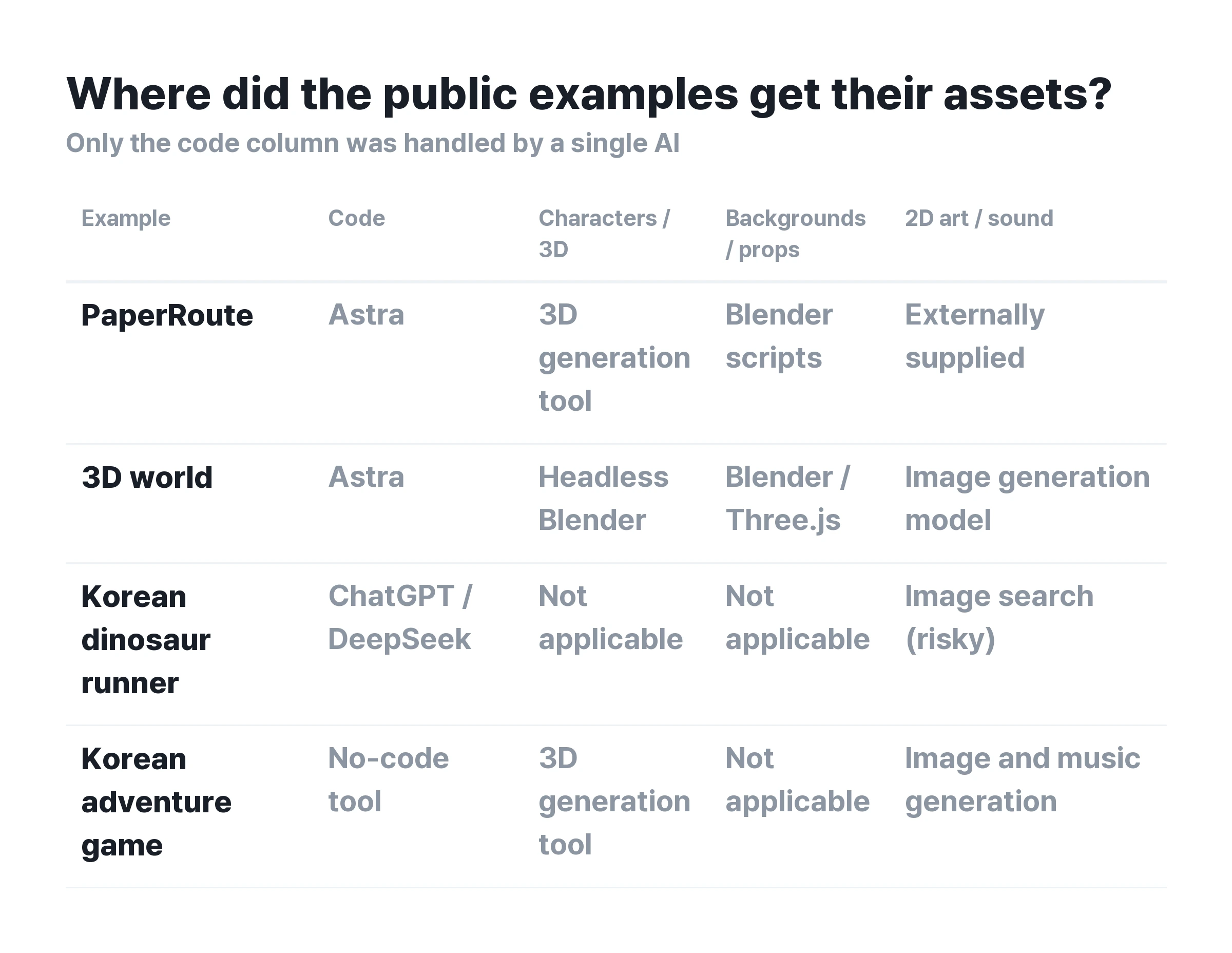
The four public examples from September 2026 examined here produced code and assets separately. There are also approaches like Carat Game Studio, where you can request a game and its assets together. The examples below therefore do not apply to every AI game tool. Here is where each existing example sourced its assets.
PaperRoute Is the Most Detailed Example
This is the example mentioned in the introduction. The creator first tried Fable, then switched to Astra after making little progress. After building an iOS prototype, they ported it to the browser. That covers the code. Hosting and a leaderboard were added separately: Vercel for deployment and Supabase for the leaderboard. This again shows that the tool handling the code does not do everything.
The assets came through three routes. Backgrounds and props were generated with Blender Python scripts so they could be reproduced. Characters came from the 3D generation tool Meshy. Astra then reduced their polygon counts and added rigging and a walking animation. The newspaper artwork and background music were sourced externally. They were not AI-generated.
Other Examples Follow a Similar Pattern
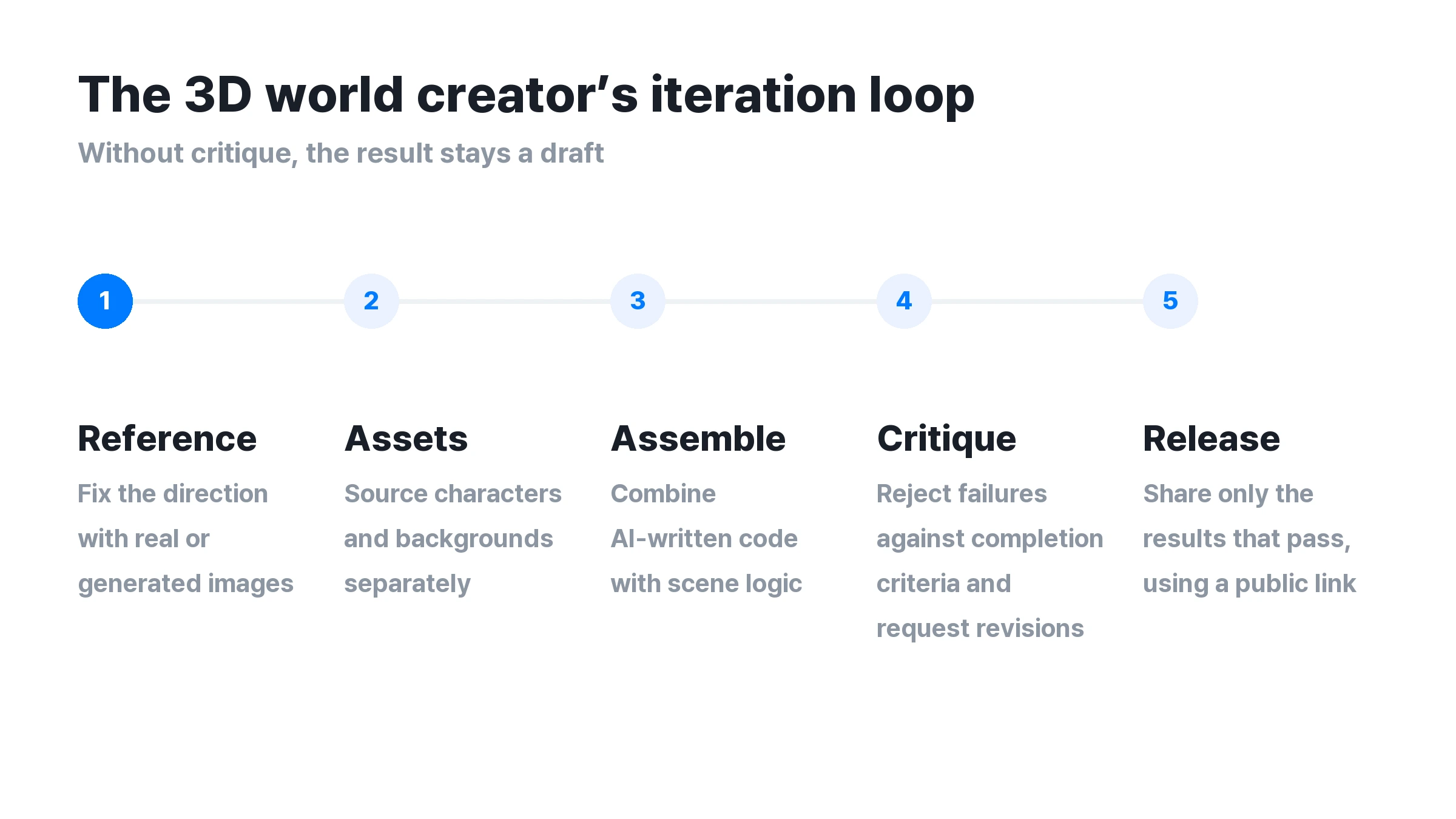
Another creator of a 3D world said they first fix the direction with reference images. Their rule is to use real photos or image generation model outputs rather than generate without a plan. Once the direction is fixed, they cycle through asset creation, assembly, critique, and release. A large AI game jam held this year received 945 games and exceeded 240,000 players. It passed 12 million views on X and drew participants from at least 50 countries. The prize pool was $40,000, and the sponsor list included a 3D asset generation tool. The event’s structure shows that assets are a separate tool stack. Its rules are also useful references. AI had to write at least 90% of the code. Games had to be free to play on the web without login or signup, with no loading screens or large downloads. These conditions show the form that current AI-made games are converging toward.
AI Game Assets: What Platforms Block
If you created assets with separate tools, check how to bring them into your game. Here is how two of the platforms introduced earlier handle image imports.
Claude Artifacts Blocks External Images Entirely
Its security policy prevents images from loading from external sources. Rather than linking sprite and background files, you must embed them in the HTML as data URIs. The rendering limit is 16 megabytes, including the images. External scripts can only load from four approved sources, and fonts are limited to Google Fonts. You cannot freely import any library you want. These restrictions come from the Claude Code Artifacts documentation. Whether the same limits apply to artifacts in the chat interface needs separate confirmation.
ChatGPT Sites Uses Uploaded Files
You can upload images, audio, and video to object storage. This means creating assets separately and uploading them is the standard workflow. Even if you generate images within ChatGPT, the files used in your game ultimately enter through this route.
What to Include in an AI Game Prompt
These are the items that recur in public examples and practical reports about making games with AI. These details, rather than the idea alone, determine the result.
-
Fix the renderer, camera type, controls, and canvas size in the first prompt. For example: “Pin Three.js to a specific version, use an orthographic camera and arrow-key controls, and create one HTML file with a 960 by 540 canvas.” Changing these later can destabilize the whole project.
-
Pin the library versions. If they drift, the model may keep calling APIs that no longer exist.
-
Request one feature at a time. If you ask for several together, you may not be able to locate the cause of a failure.
-
Ask for adjustable values to be defined as constants. That avoids regenerating everything just to change fog density or bloom intensity.
-
Fix the direction with reference images first. A description in words alone can produce something different each time.
-
Set separate criteria for filtering results. The 3D world creator said they do not use generated outputs directly; quality checks reject poor results.
Where AI Game Development Breaks Down
Graphics Details Take the Most Time
The PaperRoute creator wrote that they repeatedly corrected clothing fit, hat size, sleeves, socks, shoes, and hems. They also recorded repairing twelve UV edges on the nose. This phase sits between generating something and making it usable.
Performance Is Not Guaranteed
In the same case, 60 frames per second was achieved only once. The remaining measurements averaged between 58.3 and 58.7. The creator explicitly wrote that sustained 60 frames per second had not been demonstrated. Web graphics practitioners also identify performance optimization as a weak area. They note frequent omissions such as batching repeated object rendering or releasing resources after use.
Saving and Loading Are the Biggest Challenge
Another creator who spent two months making a game with AI in Godot described saving as the most painful part. They knew 3D but could not program, and reported burning out after working fourteen hours a day. Unlike what appears on screen, saving and restoring state requires an understanding of the project’s structure. The same account mentions context problems. For each task, they had to paste the project structure and existing code again. As the project grew, explaining it alone could take hours.
Library Versions Drift
Web graphics libraries update frequently, but the model sometimes keeps using old syntax. It calls removed functions, leaving a blank screen or causing errors. That is why you should pin the version in the first prompt.
How Much Time and Money AI Game Development Takes
PaperRoute provides the most detailed published figures. It recorded 39 hours over 11 days: 25.2 hours of human work and 13.8 hours of agent-only work. The result included 90 commits, 69 checkpoints, and 769,000 lines of code across 4,458 files. It consumed 1.56 billion tokens. Most were cache reads, with 26.2 million input tokens and 6 million output tokens. The creator calculated an API-price equivalent of about $2,175.
For reference, Astra’s official API price is $10 per million input tokens and $50 per million output tokens. Cached input costs $1 per million, so a mostly cached workload has a much lower total. Once the context exceeds 272,000 tokens, the prices rise to $20 for input, $2 for cached input, and $75 for output. Tasks that keep carrying a long context have higher unit costs.
AI Game Builders: Deployment Precautions
These are some of the obstacles that appear when you show what you built to others. Many articles on the subject barely discuss them.
-
With ChatGPT Sites, all deployed URLs are production URLs. Even a test deployment gets a real address. Saving the version, reviewing it, and then deploying is the safer sequence.
-
Deleting a site is permanent and irreversible. On Claude Artifacts Team and Enterprise plans, public publishing is disabled by default. An administrator must enable it before you can distribute links outside the team.
-
Gemini Canvas links do not open outside the Gemini domain.
-
At launch, Sites was unavailable in the European Economic Area, Switzerland, and the United Kingdom. South Korea was not an excluded region.
AI Game Asset Licenses: Can You Just Use Them
Once you publish a game by link, asset sources matter too. Even AI-generated assets have different conditions depending on the tool, so review them before publishing. Meshy’s free-plan outputs mentioned earlier use Creative Commons Attribution 4.0. You can use them with attribution, but commercial distribution requires a paid plan. Each tool sets its own rules, so check the terms of the one you choose. Precautions for using generated outputs commercially are covered in AI Image Commercial Use Precautions.
Blender AI and Game Backgrounds: Where to Get Assets
Once the code is settled, one question remains: where to get AI game characters and backgrounds.
Blender AI Operates the Tool Rather Than Generating a Model Directly
This differs from an image generation model that produces a picture. With Blender AI, an agent writes Python scripts to operate the creation tool directly. PaperRoute’s backgrounds and props used this method. The 3D world creator also ran it without a graphical interface and even delegated sculpting. Keeping the scripts makes it easy to recreate a background or vary its parameters. But you cannot review the results without knowing Blender. Public examples therefore repeatedly split the work: 3D generation tools for characters, and Blender for backgrounds and props.
The public examples used three methods: generate models with 3D tools, run creation tools such as Blender through scripts, or use image generation models for 2D art and references. The first two apply when you need 3D. For 2D games or reference anchoring, the third is enough. Even in 3D, images come first when setting the direction. The creator mentioned earlier fixed references using real photos or image model outputs before starting to model.
If you are making a game on Carat, you can request character and background creation together in Game Studio. If you want to refine images separately, check the supported models and choose one for your preferred style. Check usage conditions and credits in the plan guide and on the generation screen.
Game assets need a consistent look across images. To define a character’s appearance first, use the character sheet generator to prepare front, side, and back views as references. Check for yourself whether the generated images look like the same character and fit naturally into the game screen.
Make a Game in Carat Game Studio →
Frequently Asked Questions
Do I Need to Know How to Code to Make Games with AI?
In Carat Game Studio, you can start by describing the game you want and its controls in words. Play the first result, then adjust the difficulty or behavior one thing at a time. Games with complex saving or multiple interconnected systems may require additional checks.
Can AI Also Create Game Characters and Backgrounds?
It depends on the tool. In Carat Game Studio, you can request characters, backgrounds, and 3D assets while building the game. If you add separate images or photos, prepare material you have the right to use. Check the generated assets’ style and behavior within the game.
Which AI Game Builder Should I Use?
If you want to build games through conversation, create assets, and share by link, start with Carat Game Studio. You can also compare other tools based on the result you need, such as a single-screen prototype or a web app that requires storage. Supported features and usage conditions can change, so check before starting.
How Long Does It Take to Make One Game with AI?
One published example recorded 39 hours over 11 days, including 13.8 hours of agent-only work. However, these were measurements by one person in an uncontrolled environment, and the same article contains slightly different figures. Other development accounts describe projects estimated at one or two hours that ended up taking more than ten.