Saju Fortune
AI prompt to generate traditional Korean saju fortune chart designs.
2026.07.08
Fais « Saju Fortune » exactement comme tu veuxCrée ton propre « Saju Fortune »
Demande-le simplement — Carat génère pour toi des images et des vidéos optimisées.

Commence maintenant avec 100 crédits gratuits par jour
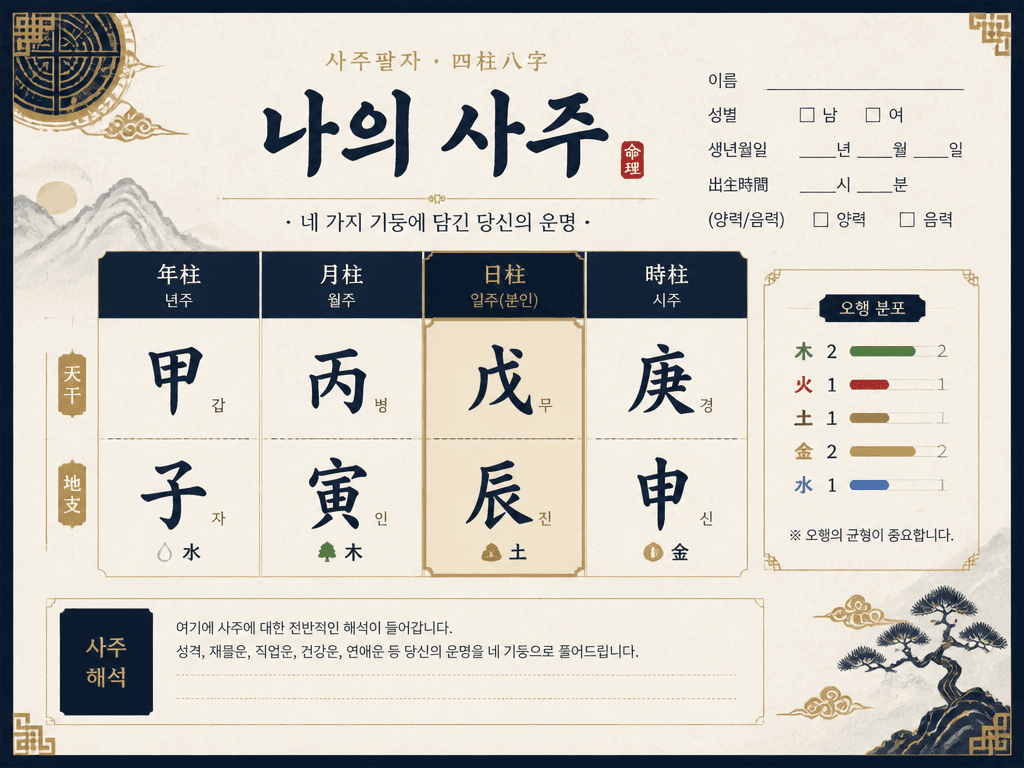
Four Pillars of Destiny Reading
What Are Saju Fortune AI Prompts?
Saju fortune prompts are input texts that use GPT Image 2 to automatically design traditional Korean four-pillars-of-destiny charts. They visually represent saju tables based on birth year, month, day, and hour, producing results optimized for fortune-telling services with hanji-textured backgrounds, bold calligraphy typography, and a gold-and-navy color scheme.
Key Use Cases
These prompts are ideal for fortune-telling apps or saju websites that need chart visualization. They work well as hero images for annual fortune, daily fortune, or monthly luck services, and can be adapted for feng shui consultation brochures or myungri academy textbook covers. Combining them with talisman imagery for New Year greeting cards is also possible.
Why This Tag Is Useful
Saju charts involve many unique visual elements such as heavenly stems, earthly branches, and five-elements arrangements, making manual design time-consuming. AI prompts can express traditional fonts, hanji texture, and gold ornamentation in one pass, dramatically reducing production time. The biggest advantage is automatically achieving the refined Eastern aesthetic needed for fortune-service branding.
Related Prompts
- Fortune Card Illustration
- Love Fortune Reading
- AI Saju
- New Year Fortune
- Daily Fortune
- Fortune Report
Prompt Composition Tips
Specifying the chart layout as 'four columns: year, month, day, hour' significantly improves accuracy in saju prompts. Use gold and navy as the base palette, and adding five-element colors (wood=blue, fire=red, earth=yellow, metal=white, water=black) yields richer results. Specify a traditional serif or calligraphy font, and adding hanji texture to the background further emphasizes the traditional feel.
Questions fréquentes
GPT Image 2 can visually represent heavenly stems, earthly branches, and four-column layouts, but it does not guarantee that the displayed data matches actual saju calculations. Use it as a visual template and input real values separately.
Adding 'Korean cheonganjiji notation' to the prompt encourages Korean output. However, AI may still mix in arbitrary Chinese characters, so post-editing to replace text may be necessary.
The default output is web-resolution. If you need full-screen mobile resolution, add 'mobile full-screen vertical ratio' to the prompt for a vertical-format result.
Images generated through Carat can be used commercially. However, we recommend that actual saju analysis go through separate specialized tools or myungri experts for verification.
Adding keywords like 'hanji texture, calligraphy style, gold-leaf ornamentation, soft muted colors' deepens the traditional Eastern aesthetic. Conversely, adding 'modern minimal, sans-serif font' transforms it into a contemporary fortune card.
Including birth date and time text in the prompt will visualize those values in chart form. However, since AI does not calculate saju accurately, the displayed values may not match the actual saju.
Specifying a 'talisman pattern insert area' within the same prompt yields a result that combines a talisman and chart. You can also generate a talisman separately with another prompt and composite them in an image editor.