
Eco-Friendly Agriculture Poster
Create eco-friendly agriculture posters with AI as a communication asset that explains soil health, water conservation, pesticide-free cultivation, and local cycles through clear icons and farming scenes.
2026.07.15
Make “Eco-Friendly Agriculture Poster” exactly the way you wantCreate your own “Eco-Friendly Agriculture Poster”
Just ask in plain language — Carat generates optimized images and videos for you.

Start now with 100 free credits daily
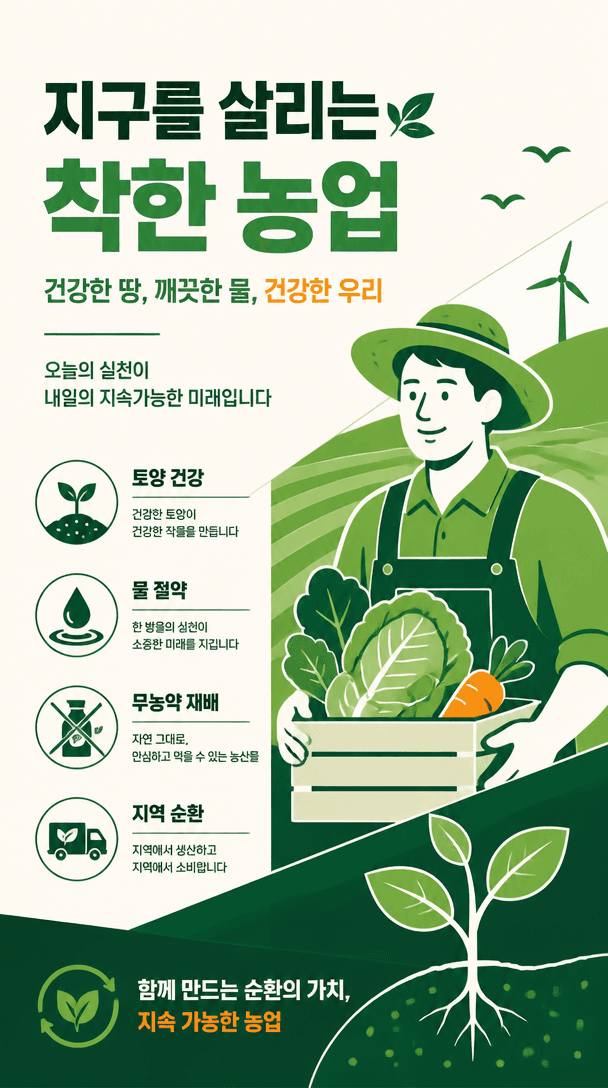
친환경 농업 포스터
What Is a Eco-Friendly Agriculture Poster AI Prompt?
A eco-friendly agriculture poster is a communication asset that explains soil health, water conservation, pesticide-free cultivation, and local cycles through clear icons and farming scenes. A useful prompt goes beyond naming the asset. It defines the audience, viewing context, first-read message, mood, palette, and spacing. Separating the hero visual from the information area makes the result easier to adapt for both vertical screens and print. This level of direction gives the image model an observable layout target instead of a vague theme.
Visual System and Information Hierarchy
Connect a farmer, healthy crops, a soil cross-section, water drops, and circular arrows into one ecological flow. Avoid relying on green alone; combine earth tones with pale blue, and pair each action with a simple icon and short explanation to build credibility. Test the composition at mobile thumbnail size and remove decorative details that compete with the title or action. Because generated lettering can contain mistakes, ask for deliberate typography zones during generation and replace critical wording with accurate editable layers during production. Clear hierarchy is more valuable than filling every part of the canvas.
Practical Uses
It works for sustainable produce campaigns, school agriculture education, local food stores, farmers markets, municipal programs, water-saving guidance, and sustainability reports. When producing a campaign set, lock the grid, logo position, and title scale, then vary only the hero image or accent color. This creates useful channel-specific versions without losing identity. Prepare separate exports for social feeds, stories, digital signage, and print rather than forcing one crowded layout to serve every destination.
Prompt Construction and Review
Do not invent certification marks. Describe observable practices such as soil care, rainwater use, and biodiversity. Keep statistics and certification claims as placeholders, then replace them with current information from the responsible organization before publishing. For print, account for bleed and safe margins. For social publishing, avoid areas covered by interface controls. Do not change every variable after the first result; revise background, subject, palette, and information density one at a time. This makes each improvement measurable and helps preserve the parts that already work.
Improving the Final Asset
Reduce the generated image to its real display size and verify that the title, hero image, date, and location remain readable in that order. Distinguish information through scale and position as well as color so the design remains accessible. Reinsert verified QR codes and contact details in the final source file. Before release, confirm spelling, schedule, venue, organizer attribution, and image rights. These checks turn an attractive concept into a dependable eco-friendly agriculture poster that supports a real decision or action.