carat

Prompt Gallery

/

Own Character Art

Login
Sign Up

Own Character Art

Develop original character designs into illustrations with consistent appearance, personality, setting, and visual storytelling.

2026.07.23

·
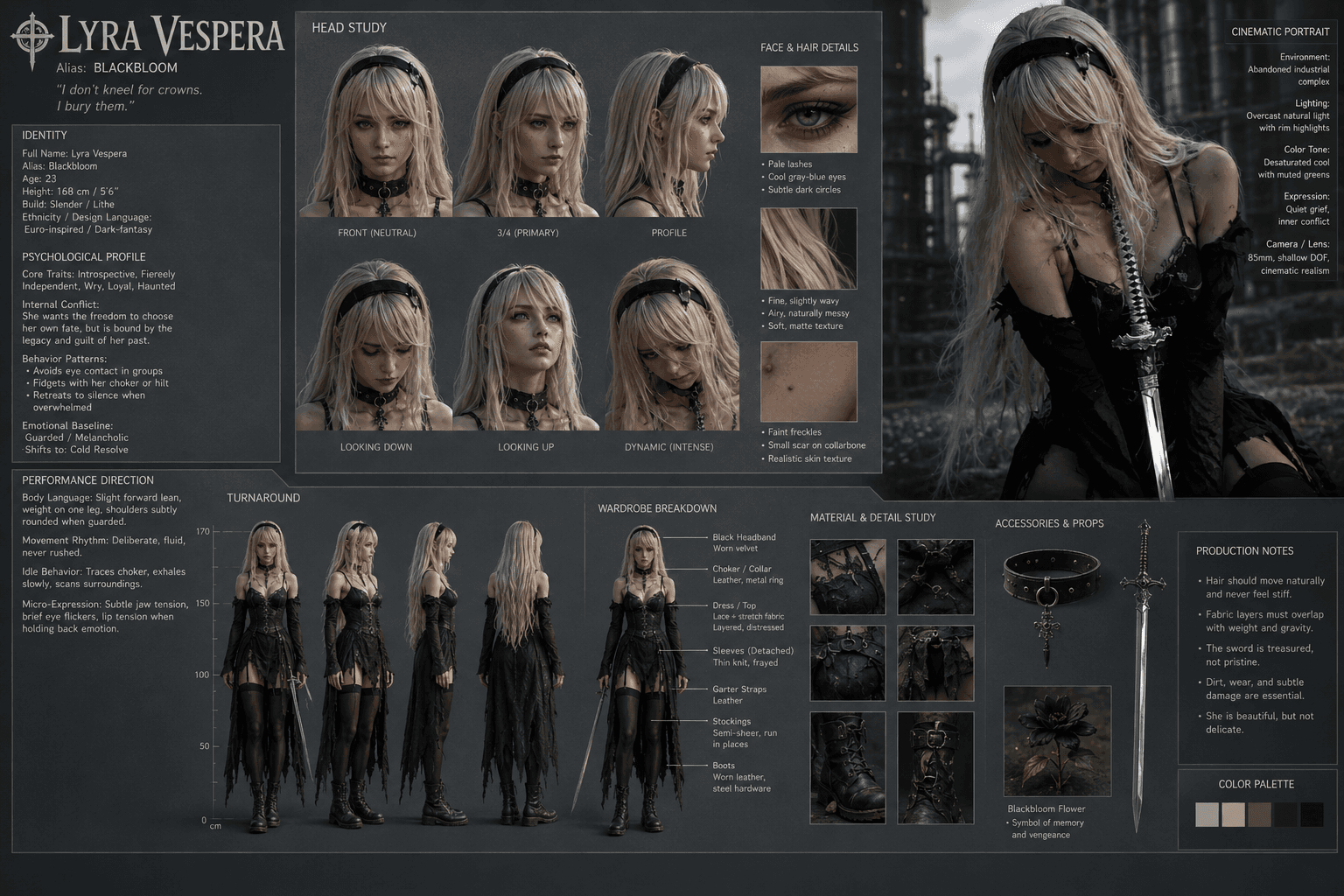
AI-generated Cinematic Character Design Sheet made with GPT Image 2

Cinematic Character Design Sheet

GPT Image 2· Image
Create a cinematic, film-production-grade character design sheet for a director, casting team, and costume department. Character name: [YOUR CHARACTER NAME HERE]. Must feel like a high-budget animated film pitch board, not a generic model sheet. CORE DIRECTIVE (NON-NEGOTIABLE): No generic layouts. No evenly spaced grids. No symmetry for symmetry's sake. Composition must feel art-directed, intentional, slightly asymmetrical. Every section must feel placed, not auto-generated. CHARACTER IDENTITY: Name: [Full name] | Alias: [Nickname or codename] | Age: [Real or stylized] | Height: [cm or ft] | Build: [Body type, proportions, posture tendencies] | Ethnicity / Design Language: [e.g. Pixar-esque, anime-inspired, culturally grounded] FACE DESIGN: Structure: [Face shape, bone structure, exaggeration level] | Skin: [Tone, texture, imperfections] | Eyes: [Size, spacing, color, expressiveness] | Hair: [Style, texture, movement, imperfections] | Distinct Features: [Scars, dimples, moles, anything unique] PSYCHOLOGICAL PROFILE: Core Traits: [3 to 5 dominant personality traits] | Internal Conflict: [What they want vs what holds them back] | Behavior Patterns: [3 habits that reveal their personality] | Emotional Baseline: [Default mood + how fast it shifts] PERFORMANCE DIRECTION: Character must feel like a real actor caught mid-moment, NOT posing. Micro-expressions required (lip tension, eye flicker, brow shift). Avoid staged symmetry. Capture transitional emotion. Body Language: [Posture tendencies] | [Movement rhythm: stiff, sharp, bouncy, dragging] | [Idle behavior: fidgeting, stillness, tension] WARDROBE: Garment 1: [fabric type, wear, imperfections] | Garment 2: [fit, distortion, stitching] | Layering logic | Footwear: [material, wear patterns] | Accessories: [items that reveal personality] | Props: [objects that reinforce who they are] MATERIAL ACCURACY: Fabrics must show stretch, stitching, wrinkles, wear. No plastic look unless intentional. Skin must have soft light interaction. Include imperfections: dirt, smudges, aging, usage marks. TURNAROUND (STRICT): Full-body front, 3/4, side, back, 3/4 back views. Identical proportions and design fidelity. No drift in face or costume across any angle. HEAD STUDY: Front (neutral) | 3/4 (primary personality) | Profile (structure) | Looking Down | Looking Up | Dynamic Angle (intense state). All expressions mid-thought, not posed. CINEMATIC PORTRAIT: Environment: [Location tied to character] | Lighting: [Practical sources, contrast level] | Color Tone: [Warm, cool, stylized] | Expression: [Specific narrative moment] | Camera: [50mm or 85mm lens, shallow depth of field, cinematic realism] LAYOUT: Clean, art-directed sheet. Neutral gray background. Include: height scale, annotation callouts, wardrobe breakdown, production notes. Must feel like a premium studio board. STYLE: [e.g. Pixar-style stylized realism / Semi-realistic cinematic design]. Must include: appealing exaggeration, soft geometry, cinematic lighting, high emotional readability. CONSISTENCY RULE (STRICT): Face, proportions, costume, and details must remain IDENTICAL across all views. No reinterpretation between angles. Ever. OUTPUT: Extremely high detail. Sharp focus. Production-ready fidelity. Suitable for film development, merchandising, and pitch decks.
b47eeec0ce8d8769e3c033cb143a18bc

What Are Own Character Art Prompts?

Own character art prompts turn an original character into a recognizable visual person whose appearance, personality, role, and world belong together. Instead of listing only hair and eye colors, define what the character wants, what they protect, how they stand, and which object represents them. Observable behavior gives the image a stronger story than abstract labels alone.

Organizing the Design

Prioritize visible information such as silhouette, face shape, hairstyle, clothing layers, signature prop, shoes, gloves, and default expression. Keep a small number of fixed traits so the character remains identifiable when the background or pose changes.

Scene and Mood

Choose a location that supports the character's role: a studio, fantasy city, school corridor, spaceship, or workshop. Add time, weather, and light direction. Background color and atmosphere can reinforce whether the character feels hopeful, secretive, energetic, or tired.

Style and Composition

Decide whether the result is a game concept image, webtoon portrait, character sheet, or action illustration. A frontal portrait is useful for checking design, while a three-quarter pose and active gesture reveal personality.

Using the Result

Select the strongest identity traits from the first result and turn them into a locked reference block. Reuse the same face, outfit, prop, and palette in later scenes. Check continuity carefully, and add tiny lettering or exact emblems during post-production when needed.

Frequently Asked Questions

Related Prompts

Mind Map

Mind Map

3 prompts

Pitch Deck

Pitch Deck

3 prompts

Product Roadmap

Product Roadmap

3 prompts

Roadmap

Roadmap

3 prompts

Carat Prompt Gallery

Create trending AI prompts instantly

Prompts

  • Logo
  • PPT Design
  • Thumbnail
  • Poster
  • Web Novel Cover
  • ID Photo
  • Caricature
  • Product Detail Page
  • Banner

Models

  • GPT Image 2
  • Seedance 2.0
  • NanoBanana Pro
  • NanoBanana 2

Carat

  • Get started
  • About
  • Blog
  • Careers
  • Contact
  • Partnership
  • Terms
  • Privacy

© 2026 Paradot.Inc All rights reserved.